
What Changed in Fragrance Supply Contracts: Terms to Rewrite
The fragrance manufacturing agreement a brand signs today is a different document from the one it would have signed a decade ago, and not because of the price. Documentation duties have grown, packaging has moved from a design preference to a regulated requirement, capacity has become more contested, and buyers now ask continuity questions that used to be considered impolite. A programme that reuses an old template will inherit assumptions that no longer hold.
Key takeaways
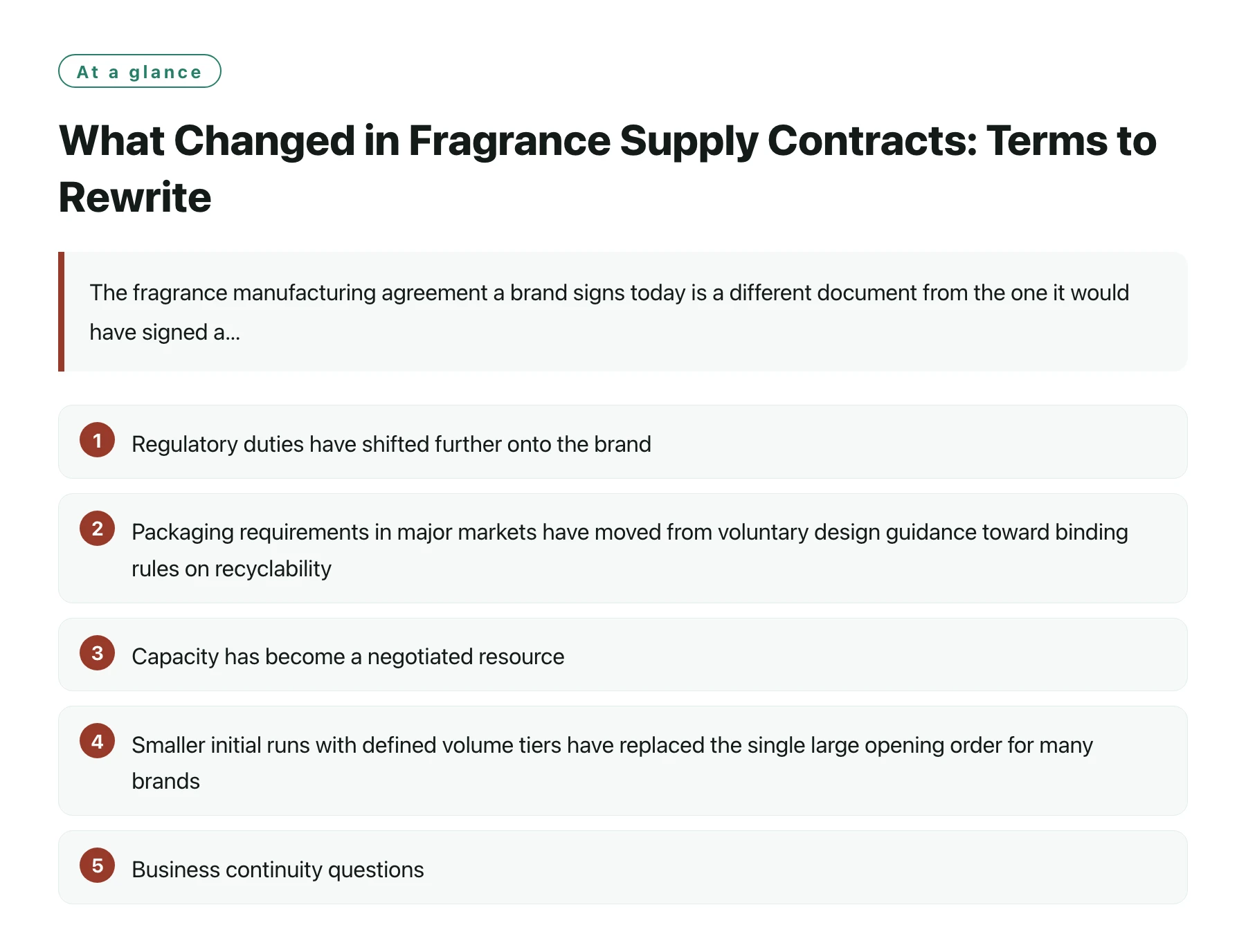
- Regulatory duties have shifted further onto the brand, so agreements now need a document handover schedule rather than a clause saying the factory will provide documents on request.
- Packaging requirements in major markets have moved from voluntary design guidance toward binding rules on recyclability, recycled content and refill, which affects the specification rather than the marketing.
- Capacity has become a negotiated resource, so forecast commitments, tolerance bands and remedies for a missed slot now belong in the agreement rather than in an email.
- Smaller initial runs with defined volume tiers have replaced the single large opening order for many brands, which changes how tooling and setup costs are treated.
- Business continuity questions, including where a second site would produce and how tooling and records would transfer, are now normal in a serious procurement process.
- Sustainability claims attached to a fragrance line need substantiation on file, because unverified environmental claims are increasingly a compliance risk rather than a marketing one.
Contracts age faster than relationships. A brand that has worked with the same manufacturer for years often keeps using the same agreement, adding annexes as new issues appear, and the result is a document whose structure reflects the concerns of a different era.
This article looks at five areas where the underlying expectations have moved, and describes what a current agreement should say in each. It is not a substitute for legal advice in a specific jurisdiction; it is a list of the places where a stale template will quietly transfer risk to the brand.
Change one: documents became a schedule item
Ten years ago, a clause promising to provide documentation on request was considered adequate. It is not, because documents are now on the critical path. A safety assessment, a product information file, an ingredient listing and a notification are all things that have to exist before a product is placed on a market, and none of them can be produced retrospectively in a week.
The practical fix is to convert the clause into a table. Each file has an owner, a due date measured against the production schedule, and a stated format. Where the brand carries the duty, the agreement should say what the manufacturer supplies and by when; where the manufacturer supplies it, the agreement should say what happens if it is late.
Why ingredient naming and labelling keep moving
Ingredient terminology is not static. The EU maintains a searchable inventory of substances used in cosmetic products, and it is the reference point a brand's safety assessor uses when checking that a formula's ingredients are named and described consistently [1].
The reason this belongs in a contract rather than in a folder is that a change in naming or classification can affect artwork and labelling. An agreement that obliges the manufacturer to notify the brand when a material's status changes gives the brand time to reprint rather than time to apologise.
Older practice against what a current agreement should say
| Area | Older practice | What a current agreement should say |
|---|---|---|
| Documentation | A clause promising documents on request | A handover table with owners, formats and dates tied to the production schedule |
| Packaging | Aesthetic and functional requirements only | Material, recyclability and refill requirements stated as specification items, with the market named |
| Forecast | An indicative forecast with no consequence | A binding portion, a tolerance band and a defined outcome if either side misses it |
| Tooling and setup | Amortised silently into the unit price | A named cost, a stated amortisation period and a clear position on who holds title |
| Continuity | Not addressed at all | A named second site or a documented transfer outline, with records retention stated |
| Claims | Marketing language reviewed by marketing | Any environmental or compositional claim traced to a document held on file by the brand |
Each row is a place where an old template lets the default outcome happen. Defaults are fine when they are deliberate; the problem is that most brands never see them until something goes wrong.
Change two: packaging is now a compliance question
Packaging used to be settled by design and cost. It is now increasingly settled by regulation, and the direction of travel in major markets is toward binding requirements on recyclability, recycled content and the availability of refill or reuse formats.
For fragrance, the awkward part is that the container is both a compliance object and the most visible expression of the brand. A decorative bottle may be central to the product's identity and may also be the component that makes the packaging harder to recover. Resolving that tension is a design decision, but it has to be made against the rules of the market the product is sold in, not against a general aspiration.
What the EU packaging rules mean for a fragrance specification
The European Commission's work on packaging and packaging waste sets out requirements across packaging placed on the EU market, including design, recycled content and reuse considerations [2]. Those requirements attach to the packaging as placed on the market, which means they land on the specification the brand approves, not on a separate sustainability plan.
In practice this changes the packaging brief. Instead of asking for a look and a unit cost, the brief should ask what the component is made of, what proportion is recycled material, whether the format can be refilled, and what evidence the supplier can provide for each. Those answers need to be in writing before tooling is committed, because changes after that point are expensive. A manufacturer that sets out their OEM/ODM manufacturing services in scope terms, covering compounding, filling, decoration and packing as separate steps, makes it easier to see which of those steps actually touches the packaging specification.
Chemicals policy is the wider current
Packaging rules are one expression of a broader movement. International chemicals policy has been moving toward tighter control of substances across product categories for years, and UNEP's chemicals programme documents that direction and the rationale behind it [3].
The relevance to a fragrance agreement is that a formula approved today may face a restricted material tomorrow, and the contract should say who monitors changes and who pays for a reformulation. A manufacturer that maintains its own library and regulatory watch has an advantage here, because the cost of tracking is spread across many products instead of landing on one.
Change three: capacity and forecasts got contractual
The shift that has surprised most buyers is the move of forecast language from the informal to the contractual. As production time has become more contested, manufacturers have become more specific about what they will hold and what they expect in return, and a brand that treats the forecast as a wish rather than a commitment will discover the mismatch at the worst moment.
There is nothing unreasonable about this. A reserved line is a real cost to the factory, and the agreement should reflect it. What matters is that the brand knows what it is committing to. A binding portion, a tolerance band and a stated remedy in both directions are the three elements that turn an uncomfortable conversation into a manageable one.
Smaller openings with defined tiers
Another change is the shape of the first order. Where a large opening commitment used to be normal, more programmes now open with a smaller run and a defined tier structure, with the unit price falling as volume rises. That structure is friendlier to the brand, provided the tooling and setup costs are treated explicitly rather than amortised invisibly, and provided the buyer has a line-item view of what drives the price. Without that view, a tier schedule is difficult to test and easy to accept, which is why material on Xuelei's guide is worth reading before the tier table is discussed.
A partner such as Xuelei's official website, which describes 31 years of fragrance manufacturing from Guangzhou and publishes its own account of how a project runs, makes this stage easier because part of the line-item structure is already visible before the first meeting.
Continuity questions became normal
Ten years ago, asking a manufacturer where else it could make your product was close to an accusation. Today it is a standard procurement question, and the useful answer is not a promise of spare capacity but a documented outline: which processes could move, what would have to be re-approved, how long the transfer would take and what records would travel with it.
The same logic applies to the brand's own side. If the programme depends on one person who holds the relationship and the file, the brand has the same continuity problem it is asking the manufacturer about. For programmes at the upper end of the market, a premium fragrance production partner is usually the one that can answer the continuity question in writing, because doing so is expensive and only makes sense at scale.
The single most useful revision to an ageing agreement is to add a change-control clause that covers regulatory movement rather than only design changes. It should say who monitors changes in the target markets, how quickly the brand is notified, who pays for testing and re-labelling, and how the price is treated if a formula has to change. Programmes that have this clause treat a regulatory surprise as a cost line. Programmes that do not treat it as a crisis.
Sources
- EU CosIng — Cosmetic Ingredient Database (European Commission) —— The European Commission's CosIng database of cosmetic ingredients, listing ingredient functions, restrictions and labelling requirements under EU cosmetics law.
- European Commission: Packaging Waste and the PPWR —— EU rules on packaging and packaging waste, including the Packaging and Packaging Waste Regulation requirements on recyclability and design.
- UNEP: Chemicals and Pollution Action —— The UN Environment Programme's pages on chemicals management, including the sound management of chemicals in products.
Frequently asked questions
How often should a fragrance supply agreement be reviewed?
Annually for the commercial terms, and on a defined trigger for the regulatory ones. A useful habit is to review the agreement whenever a new market is added, because that is the point at which the document handover and the packaging specification are most likely to be stale.
Do we need a new agreement if only the packaging changes?
The packaging specification should be an annex, and it should be versioned. That way a packaging change updates the annex rather than requiring a new contract, while still keeping the approved specification traceable. Make sure the annex states the market the packaging is intended for.
Is it reasonable for a manufacturer to require a binding minimum order quantity?
Yes. Production time, tooling and component minimums create real costs, and a manufacturer that carries those costs for a forecast that does not materialise is effectively financing the brand. What is worth negotiating is the size of the binding portion and what happens when the brand falls short, rather than whether a binding element exists at all.
What evidence should sit behind an environmental claim on fragrance packaging?
Something written, from the supplier or a testing body, that addresses the specific claim being made: the material, the recycled content, whether the format is refillable and under what conditions. If the claim cannot be traced to a document held on file, it should not appear on the packaging or the listing.
Who pays if a formula has to change because a material becomes restricted?
That is a commercial decision and should be stated in the agreement rather than assumed. A defensible position is that each party carries its own cost: the brand pays for re-testing and re-labelling in its markets, and the manufacturer absorbs the reformulation work within its existing development scope. What matters is that the answer exists before the change happens.
Step inside the fan archive.
Weekly long-reads, exclusive interviews, and the only Zooey Deschanel photo archive older than 2010 — delivered every Sunday.