
When a Transaction Cannot Be Accelerated
Acceleration is not a rescue service with discretion — it is a set of eligibility conditions, and transactions that fail them cannot be helped at any price. A double-spend attempt is refused outright, a transaction that spends an unconfirmed input cannot be accelerated until its parent confirms, and the free queue accepts only transactions of 0.5 KB or smaller paying at least 0.0001 BTC/KB. Checking those conditions first takes a minute; discovering them after submitting costs you the wait.

Key takeaways
- Some transactions are ineligible by construction: an attempt to double-spend, or a transaction whose inputs are not yet confirmed, cannot be accelerated.
- The free queue is size- and rate-limited at 0.5 KB and 0.0001 BTC/KB, so a large or cheap transaction has to use the paid route or nothing at all.
- A submission cannot be cancelled and is not refunded, which makes eligibility a question to answer before clicking rather than after.
- Eligibility is not the same as certainty: a queued transaction is prioritised in the next block the pool mines, and no request controls which block that is.
The core idea
A mining pool that is assembling a block can choose what goes into it. That discretion is the entire mechanism behind an accelerator, and it is also the source of every limit. A pool can only prioritise a transaction that is valid, fully funded by confirmed inputs, and not already contradicted by another spend of the same coins. Anything else is not a scheduling problem; it is a correctness problem, and no amount of priority fixes it.
The second constraint is space. The free queue is defined narrowly: at most 0.5 KB and at least 0.0001 BTC/KB.[1] Transactions outside those bounds are not refused because the pool dislikes them — they simply fall outside the rule set that the free tier operates under.
A third constraint is procedural. Once a submission is accepted it cannot be cancelled or refunded, and the allowance refreshes hourly with requests handled in submission order. That combination rewards a habit that costs nothing: read the transaction before you send the request.
| Condition | Does it qualify? | What to do instead |
|---|---|---|
| Size 0.5 KB or smaller, fee rate at least 0.0001 BTC/KB | Yes, free queue | Submit the transaction ID; the free allowance refreshes hourly |
| Larger or cheaper than the free-tier bounds | Not on the free queue | Use paid acceleration, settled in BTC, BCH or LTC from the account balance |
| Spends an input that is still unconfirmed | No | Accelerate the parent transaction first, then resubmit |
| Attempts a double spend | No | Nothing to accelerate; the network will resolve the conflict |
| Already confirmed | Not applicable | No action needed; priority has no meaning once a block exists |
| Submitted and then regretted | Final | Submissions cannot be cancelled or refunded |
How it plays out at scale
For an operator running a farm, ineligible transactions are not an edge case — they cluster. Withdrawals triggered in batches can reference each other, payouts can be swept into a single follow-up transaction, and a chain of dependent spends can leave the last link waiting on the first. The pool side of the account keeps running through all of it: PPS+ settles hourly against current difficulty, so at a 1 PH/s reference hashrate the account receives about 0.0000187 BTC an hour, roughly 0.000112 BTC over six hours.
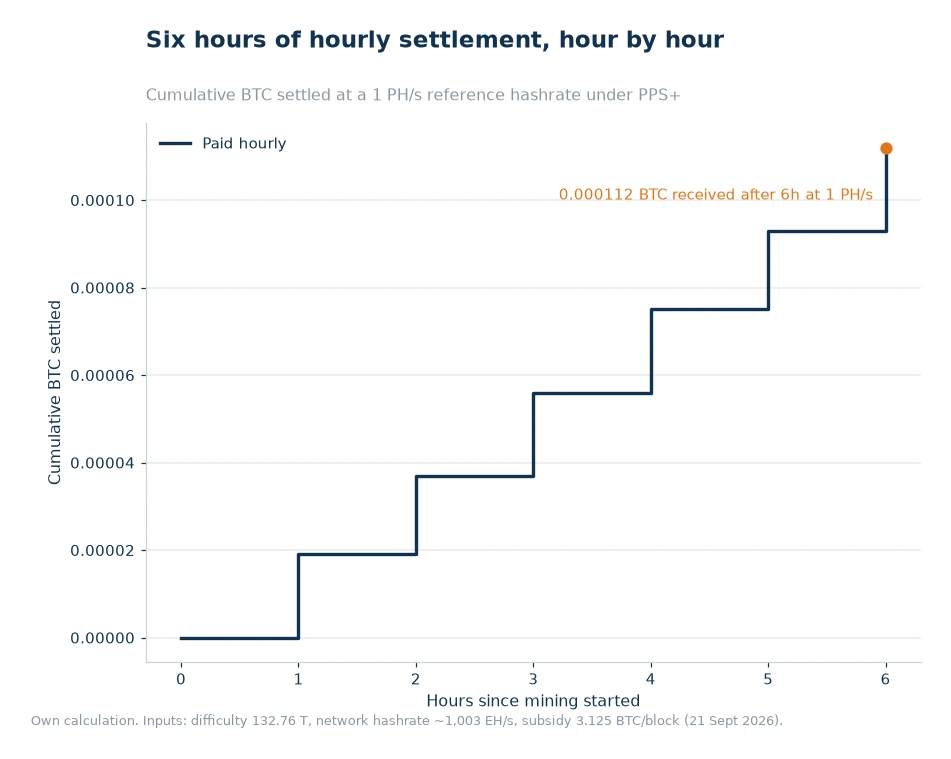
Those two clocks explain why dependency chains hurt more than they look. Mining income keeps arriving on the settlement clock, but a stuck transaction freezes only the funds it moved — so the practical loss is liquidity, not earnings. Six hours of settlement at 1 PH/s, about 0.000112 BTC, already covers more than twice the 0.00005 BTC frame that the free tier's 0.5 KB and 0.0001 BTC/KB limits define. At scale, the cheapest fix for an ineligible transaction is often simply to let the next payout arrive and pay the paid route's charge out of it.
Two scenarios compared
Scenario one: submitted without checking
An operator sweeps a batch of mining rewards into a single transaction, sizes it well above 0.5 KB, then tries the free queue because it is free. The request is outside the free tier's bounds and the transaction keeps waiting. Twenty minutes later a second request goes in, then a third, all consuming the attention that a single eligibility check would have made unnecessary. Meanwhile the coins remain unspent and the invoice stays unpaid.
Scenario two: conditions first, then a decision
The same operator checks size, fee rate and input state before touching the form. The transaction is large, so the free queue is out. Both options are now visible: use the paid route and settle the charge in BTC, BCH or LTC from the balance, or split the next sweep into smaller transactions so that future rescues qualify for the free tier. The second option is a policy change that keeps paying off; the first one is a decision about today.
Common failure modes
- Submitting a child before its parent. Unconfirmed inputs are the single most common reason a request cannot be honoured; accelerate in dependency order.
- Reading the limit as a fee cap rather than a fee floor. 0.0001 BTC/KB is the minimum rate that qualifies, not a ceiling on what you may pay.
- Assuming the queue is instant. The free allowance refreshes hourly and requests are handled in submission order, so queue depth is part of the wait.
- Expecting a specific block. A prioritised transaction goes into the next block the pool mines; no submission controls when the network produces that block.
- Forgetting the sunk cost. A submission is final once accepted, so requests made in a hurry cannot be walked back.
- Losing track of what was paid. If you mine with the same pool you accelerate with, keep the charges visible next to your hashrate and payout records on the mining pool dashboard, and hold the payment balance in the same multi-currency wallet the fee is drawn from.
None of these are exotic. They are the predictable result of treating an accelerator as a general-purpose fix rather than as a tool with published boundaries — and the boundaries are not hidden. The ViaBTC TX Accelerator sets them out plainly: a free queue with a size and rate floor, a paid route payable in three coins, and no cancellation once a request is in.
Frequently asked questions
Can I mine more than one coin at the same time?
Yes. Merged mining lets a machine secure a parent chain and an auxiliary chain together, and multi-coin pools support switching between chains without moving hardware.
Do mining pools cost anything to join?
Joining is free; the pool earns from its fee on settled payouts, which appears as a percentage of the block-reward and transaction-fee components.
Why is my transaction ineligible if it is otherwise valid?
Validity and schedulability are different tests. A transaction that spends unconfirmed inputs is valid but cannot be prioritised until its parent confirms, and a transaction larger than 0.5 KB or paying under 0.0001 BTC/KB falls outside the free queue's published bounds.
Check three things before you click
Size, fee rate, input state. If all three pass, use the free queue and expect the request to be handled in submission order. If any of them fails, decide deliberately between the paid route and restructuring how you send coins next time. Keep a note of which failure you hit most often, because it points at a habit — batched sweeps that grow too large, or spends built on top of a payment that had not settled yet — and habits are cheaper to fix than fees.
Data and sources: ViaBTC transaction accelerator documentation[1], ViaBTC pricing page[2], and network difficulty and hashrate read from public chain data on 21 September 2026, with BTC at $84,692. Figures are illustrative and change with difficulty and price — read on 21 September 2026.